Report by Françoise Spiekermeier
A weekend in Ibiza, out of season
Far from clichés, Ibiza is an invitation to an initiatory journey, to let go of one's chrysalis. Plume prefers it out of season, in its simplest form.
A magnetic pole on the international party map, a rendezvous for pleasure and artificial paradises, and a pantheon for the show-business stars who find refuge there, Ibiza has been attracting moths like an irresistible light since the 30s, 60s or the depths of antiquity. The archipelago it forms with Formentera and neighboring islets was known as Pityuses, "the islands of the Pines" under the Greeks and Romans. Before them, the Phoenicians from what is now the coast of Lebanon brought with them Egyptian gods: Tanit, the goddess of femininity and love, and Bès, the ungainly god of fertility, dance and the home, present on the capital's coat of arms.
Discover Ibiza's other character, against the current.
FROM BARCELONA: NIGHT CROSSING
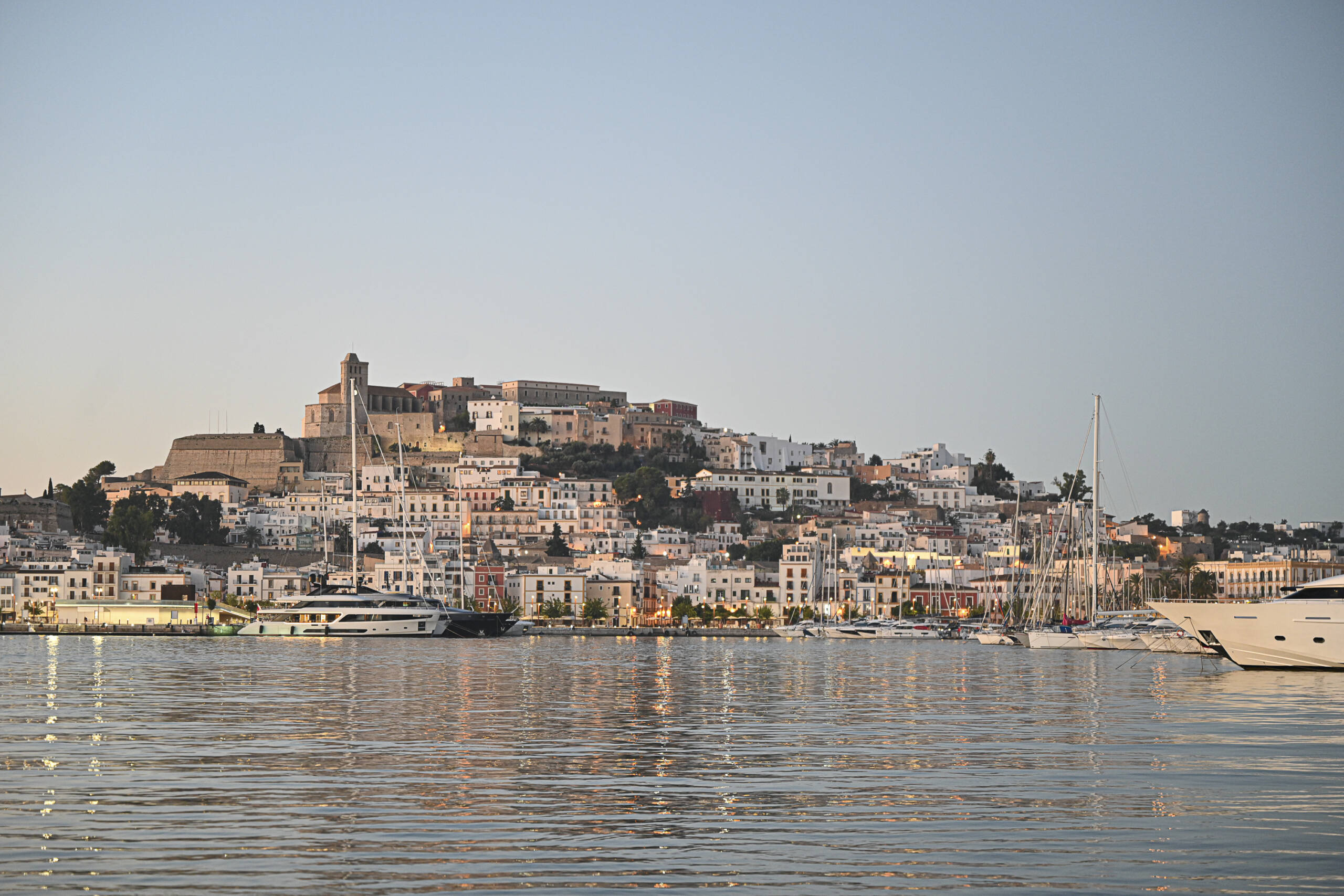
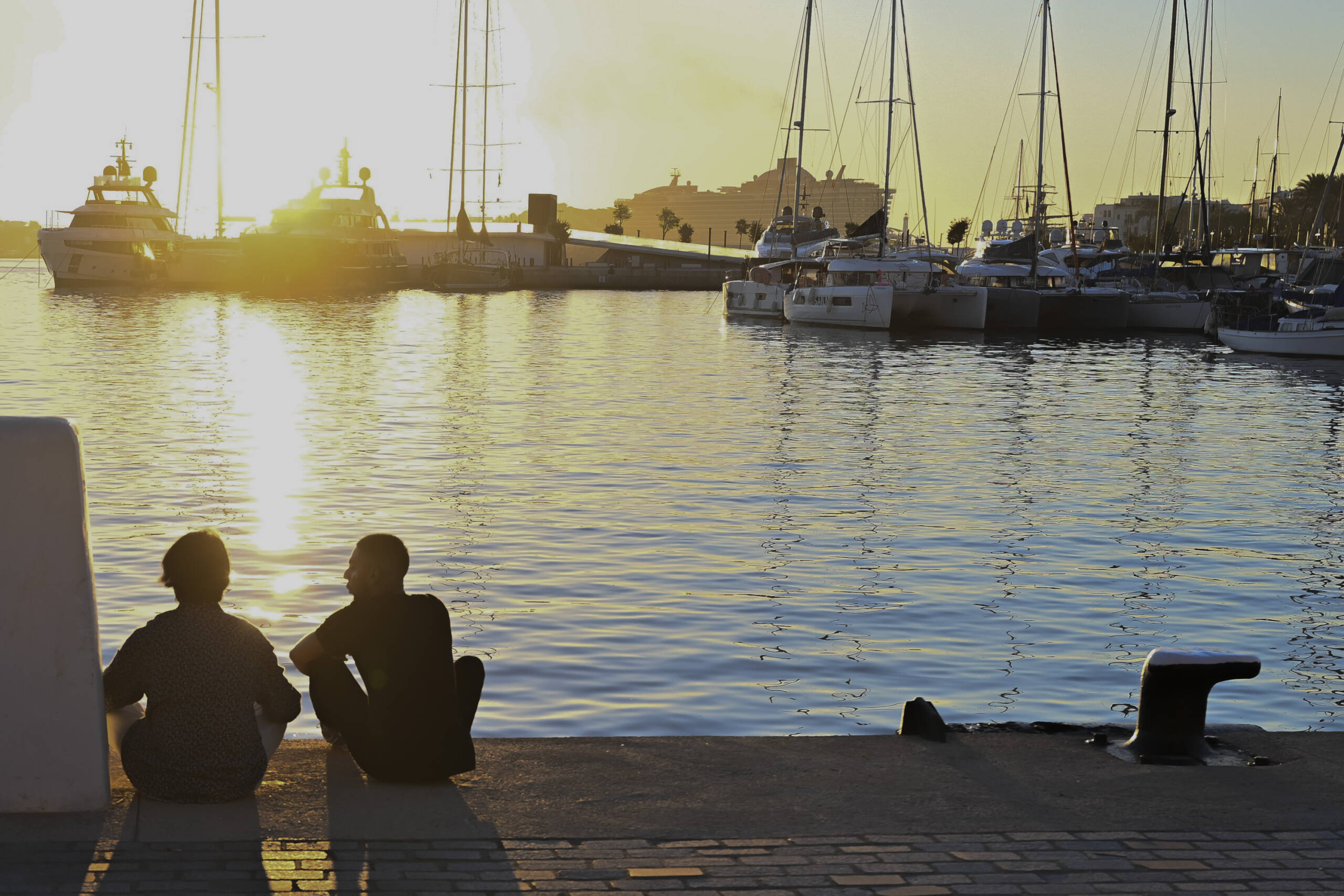
Choose to approach the island by sea: the ferry from Barcelona arrives at dawn in the port of Eivissa, the island's capital. After an overnight crossing. The whale's belly opens up, and the vehicles emerge in single file with a metallic din, heading off in many different directions. It all begins here. Electrical contact: creatures in stiletto heels and fishnet jumpsuits cross the road in search of a beach or a bed to end the night. Le Pacha, the mythical club for the international gotha, opened in 1973 and hosts the island's wealthiest clientele and most expensive parties to the sound of the greatest DJs of the moment. The famous Flower Power party on Wednesday nights is a ritual not to be missed by those nostalgic - or not - for the hippie movement. But between late October and April, all is quiet. You can hear the seagulls flying, and the port is deserted. We go for our first coffee - with milk and croissants - at the Club Nautique, to meet the regulars and read the local newspaper. From the terrace overlooking the port, Dalt Vila, the old fortified town founded by the Phoenicians from Carthage in the 8th century BC, dilutes its reflection in the water. The wharves, dominated by whitewashed facades, are bathed in a soft, easy-going atmosphere, shaded by the occasional palm tree. The air is crystalline.
THE OLD TOWN
Climbing up to Dalt Vila - the upper town - invites you to sample the island's relaxing atmosphere. Particularly on Sunday mornings, when the only people you'll see are cats! Starting from the covered market square, at the foot of the Portale de Ses Taules (the main gate) flanked by Roman statues, climb the narrow, cobbled streets of the ancient fortified town, declared a World Heritage Site by UNESCO in 1991. Bohemian style spreads like wildfire from store to shop: the centurion's toga has given way to long, natural cotton shirts made in India - the same ones the beatniks brought back to subsist on while waiting to return to Goa. You'll find straw sandals made on the island, mingled with handcrafted decorative objects in natural materials... Café terraces invite you to spread out on cushions placed on the steps in the middle of the street, or on rattan armchairs in the shade of a hundred-year-old carob tree. The heartbeat slows, time stands still, space expands and invites you to cultivate your artistic fibre, to draw inspiration from a reservoir of ideas that speak of simplicity and spontaneity. We breathe! Faces put on a smile! Calle Major gives an idea of the sumptuous residences hidden behind the heavy, closed, studded wooden doors of the 16th-century Hotel La Torre del Canonigo... Opposite it, the door to the artist's den is always open: Traspas and Torijano are painters, but they also sell talismans bearing the effigy of the gods Bès or Tanit, supposed to bring protection. He and his wife are a mythical couple on the island for their longevity!
Once you've reached the top of the old town, the view from the ramparts stretches to the horizon, revealing a coastline of jagged, tortured limestone, glistening in the sunlight. But you have to go underground to catch a glimpse of one of Ibiza's mysteries. To go from light to shade and into the necropolis of Puig des Moulins. Labyrinths carved into the rock hide no less than three thousand tombs. In ancient times, this crypt was built by the Phoenicians to conceal the graves of wealthy families who crossed the Mediterranean to be buried in Ibiza. As the island was devoid of any snakes or poisonous insects, it was considered to be a paradise, or at least a direct route to the abode of the gods. Wealthy Phoenicians were buried here with treasures that attracted pirates, who for centuries turned these waters into troubled waters. A visit to the nearby studio of painter Rom Ero, who paints posters for Flower Power evenings at the Pacha club, is a must. He has chosen to paint the gods Tanit and Bès, who haunt his imagination.
START OF TRIP
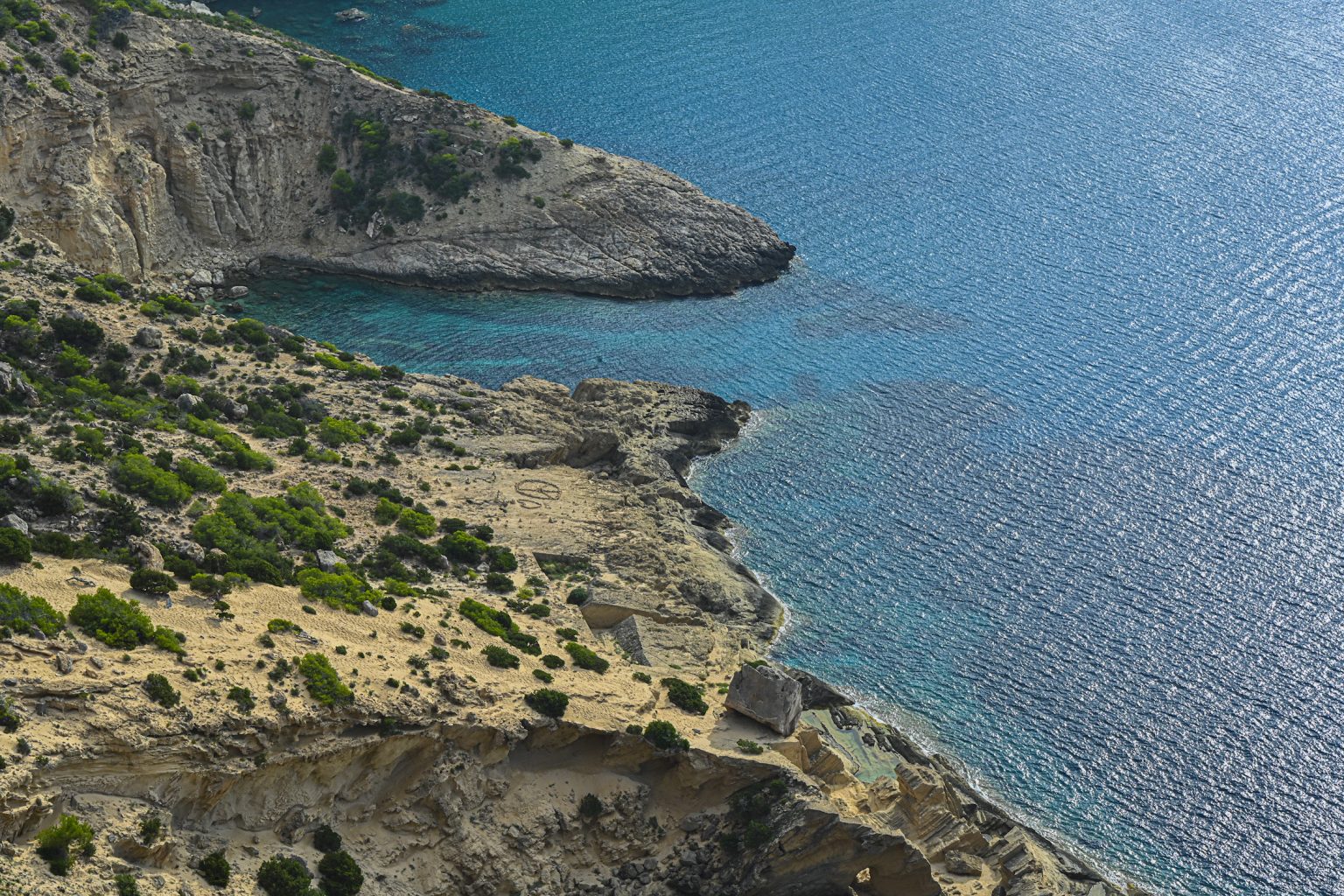
The island is very steep, surrounded by cliffs and stretches of coastline that are inaccessible for many kilometers. Except perhaps on the south-east coast, where there are sandy beaches and waves for surfing... For a surface area of 572 km 2, which can be crossed from one end to the other in less than an hour, there are no less than sixty accessible coves, beaches and small harbours. You'd need to stay a month to see them all, visiting one cove by day and another at night to watch the sun set - which is a way of life here. The question is: where to start? Local Instagram accounts are a good place to start the treasure hunt, but if you're going to let loose, you might as well forget your cell phone for a while... Rely on encounters to draw your own personal map of the island, based on the experience of others and free sharing, living "the old-fashioned way"... in the days before artificial intelligence.
IBIZA IN THE SOUTHWEST
You're struck by the island's wild nature. It lives up to its name, the island of pine trees, with which it is covered as far as the eye can see. Heading south. There are few villages on the island: just fifteen or so. And in this region, there are two: San Josep and Es Cubels, separated by Mount Sa Talaia, the island's highest point at 475 m, on the same longitude as Eivissa.In San Josep, the artisanal market is ideal for buying locally-made bags and sandals, then shopping before enjoying a fruit cocktail at the Racó Verd café, and in San Cubels you can soak up the authenticity of local life close to the island's traditions.Not far away is Ibiza's magnetic pole: the fantastic Es Vedrà rock, emerging from the sea with its cloudy cap. This 385-metre-high sugar loaf, inaccessible to ordinary mortals - which airline pilots fly around to avoid disrupting their navigational instruments - is said to be a base for flying saucers... Its triangular top concentrates energy, and the whole island gives off a powerful magnetic field. Head for Cala d'Hort, a beach in the south-west of the island that faces the sunset in summer. It's the scene of pagan rituals: hippies used to gather here in the evenings to celebrate sunset. The two restaurants are packed every evening in season, and traffic is saturated along the path that leads from the road to the lookout on the edge of a cliff towards the Torre des Savinar (one of six 18th-century ford towers on the island).
MYTHOLOGIES AND MYSTERIES
The island is under the protection of the goddess Tanit, goddess of love. Yes, but tough love, as she is said to take pleasure in separating the couples who stay there. The first visual contact with Es Vedrà is subjugating, obsessive. So much so, in fact, that you can't tear yourself away from it. Even as you explore other parts of the island, you're reminded of the imaginary silhouette that slips away. The spectacle of the rocks, vibrant with changing colors as the day progresses, and its opaque imprint on the screen of the starry sky, fascinate. Seen from the deck of a boat, it's a trip! This is where, according to Homer in The Odyssey, Ulysses asked his crew to tie him to the ship's mast to listen to the sirens' song, and resist their fatal seduction that drives sailors to dive into the abyss to join them.
IBIZA TO THE WEST
At the wheel, you follow the winding curves of the road through beautiful countryside. Heading up the west coast, past the port of Sant Antoni de Portmany, you reach Cap Negret. Take a quick dip in Cala Gració, an idyllic cove with turquoise and green waters dominated by luxurious white villas... Hurry to the wooden terrace of the hotel and restaurant La Torre Ibiza, ideally positioned on the ochre rock between Cap Negret and Punta de sa Galera, in an impressive mineral cirque overlooking the sea. In the off-season, the hotel puts you at the forefront of nature's spectacle, the stage for a technicolor show when sunset arrives and the chill-out sound track is composed by the in-house DJ. We cross the island to come to this end of the world to sip a cocktail and clear our heads, facing the sea. Some prefer to head further north, cutting through unspoilt countryside towards Santa Gertrudis de Fruitera, then Santa Agnès de Corona and its beautiful whitewashed church, to reach Benirràs, where djembe players gather on the beach every Sunday evening for an all-nighter.
IBIZA IN THE CENTER
With its hippie culture and Indian influences, Ibiza is an ideal destination for yoga. Cultivating its healthy personality, Ibiza's agriculture is organic, with the majority of farms located in the center of the island. Among these, the most glamorous is Terra Masia, a vast permaculture property producing seasonal vegetables offered in the daily basket, or cooked by the chef in colorful plates to be enjoyed under a pergola opening onto the garden. All plants are grown on site, including the lavender that lines the shady paths beneath the cypress trees. Created by a star DJ, the farm will soon be producing its own organic vodka, of course!
IBIZA IN THE NORTH
Covering an area of 572 km 2, which can be crossed from one end to the other in less than an hour, there are no less than sixty accessible coves, beaches and small ports. You'd need to stay a month to see them all, visiting one cove by day and another at night for sunset - which is a way of life here. The island is very steep, surrounded by cliffs and stretches of coastline that are inaccessible for many kilometers. Only the south-east coast has a collection of wave-beaten sandy beaches, ideal for surfing. But it's in the north that you have to go to discover La Cala Nova, assures Denise, an ayurvedic masseuse who has been on the island for 5 years. "At the end of the beach, there's a white rock in the shape of an egg: it's an energetic dimensional gateway, ideal for meditation. The beautiful beach of Cala Nova seems inaccessible: a rain-soaked path leads down into a dusty valley. We double-park between pine trees and surfers' vans. The Energy Gate is also the best surfing spot on the island. There's only one step from Cala Nova to Las Dalias. The one that takes you to the north of the island, to the village of San Carlos, where you'll find the Las Dalias hippie market, which in summer ends with live concerts and an open-air party that goes on until the end of the night. Here, you can buy little bags in which to put a bit of Ibizan earth. Until the 80s, this was the tradition. The white earth of Ibiza, worn as a talisman around the neck throughout the journey away from its shores, enabled people to benefit, from a distance, from its protective magic.
EAST COAST
And here's the island's most urbanized face on a coast lined with white sandy beaches: Cala Martina, Cala Nova, Cala Llonga...
Whatever you come for, Ibiza ends up as a journey of initiation. The chrysalis cracks. Even out of season, against the current, diving into the heart of its natural rhythm, it's impossible to escape its magnetism.
In the 1930s, Europe's enlightened minds, artists and philosophers, came here to melt into nature and escape the rise of fascism. Among them was Albert Camus, who used to sit in the harbour cafés: "I wanted to love as one wants to scream. It seemed to me that every hour of sleep would be stolen from my life"...he wrote in "L'envers en l'endroit" (1937). In the post-war years, Hollywood stars from Elisabeth Taylor to Errol Flynn came here in search of anonymity. In 1967, the "Summer of Love" of anonymous hippies mixed with stars -Nico, Georges Harisson- in search of an ideal, definitively stamped the libertarian spirit that still vibrates in the air and makes beautiful people fantasize.
But between late October and April, all is quiet in Eivissa. You can hear the seagulls flying, and the port is deserted. We go for our first coffee - with milk and croissants - at Club Nàutico, to meet the regulars and read the local newspaper. Seen from the Yacht Club's terrace, ideally placed on the marina, Dalt Vila, the old fortified town founded by the Phoenicians from Carthage in the 8th century BC, dilutes its reflection in the water from the top of its promontory. The high voltage of summer sinks into the black waters of the port. The quayside, dominated by whitewashed facades, exudes a softness of life. The air is crystal-clear under the light shade of a few palm trees.


